
Any nREPL server: babashka, other Clojures, other hosts
Part of Dialects and runtimes.
{:dialect :nrepl} in .jonquil.edn attaches to an nREPL server you started: babashka, Basilisp, or one on another machine. Jonquil connects on the first Run and never starts or stops it. A feature works when the server's describe reply offers the op behind it, and the start lines say which ones are missing.
:nrepl says where to connect:
{:dialect :nrepl :nrepl {:port 1667}}                 ; this machine
{:dialect :nrepl :nrepl {:host "box" :port 1667}}     ; another one
{:dialect :nrepl :nrepl {:port-file "tmp/nrepl.port"}} ; read the port from a file
With no :port, Jonquil reads :port-file, then .nrepl-port in the project. The host defaults to 127.0.0.1. An unusable value (a port outside 1-65535, an absolute :port-file) warns in the console and uses the default.
babashka: bb nrepl-server writes no port file, so name the port:
bb nrepl-server 1667
Basilisp: its server writes .nrepl-port in the folder you start it in, so {:dialect :nrepl} alone is enough:
basilisp nrepl-server
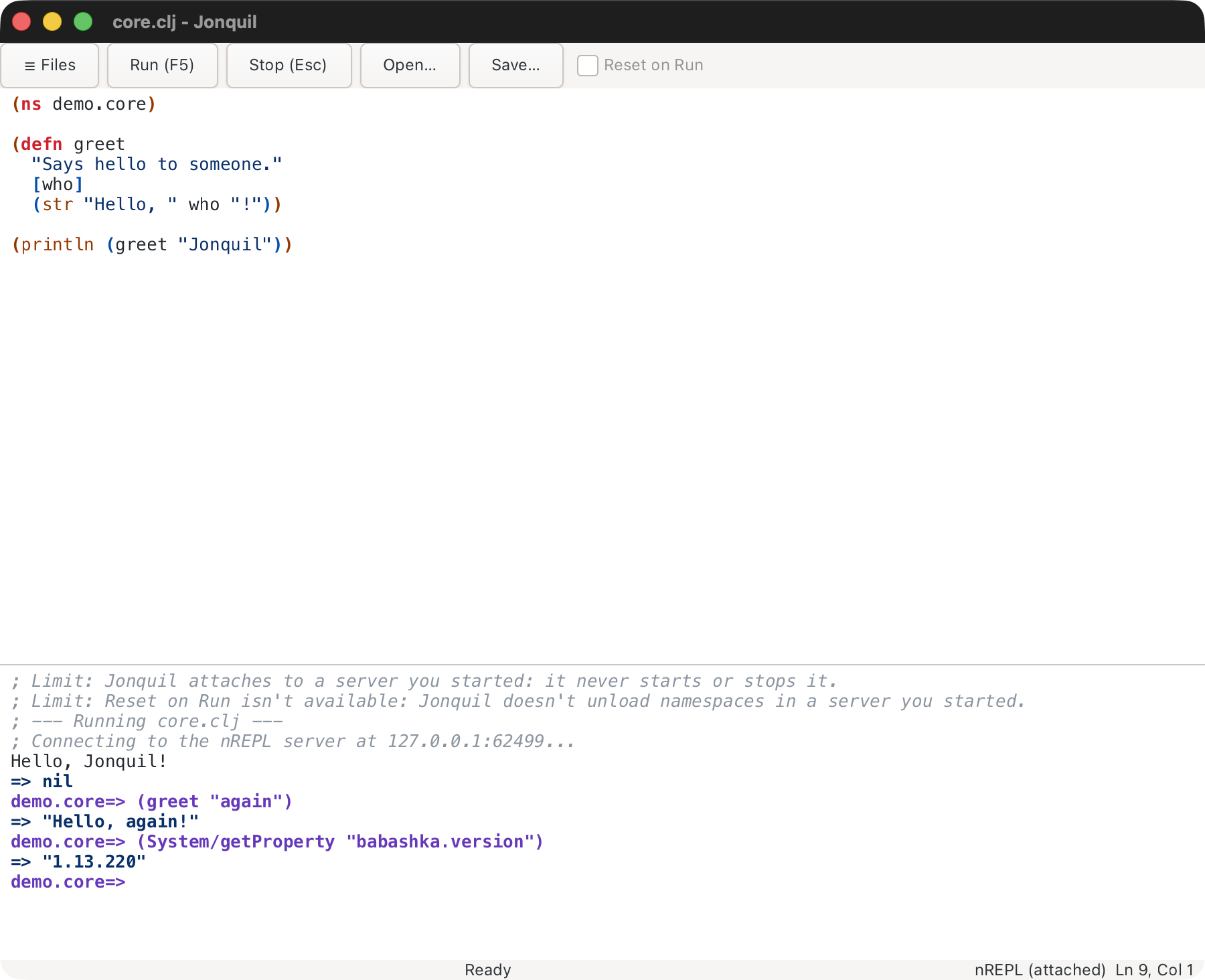
Run, the REPL, quick docs and completion work on both. Neither has an interrupt op, so Stop disconnects and the evaluation keeps running on the server. Neither has stdin: on babashka read-line waits until Stop; on Basilisp type the line in the terminal running the server. Jump to definition stays in the buffer for library functions on babashka, since it names a file not on this disk. See Known limits.
A remote server is unauthenticated code execution, now on the network. Keep it on a trusted network or tunnel it: ssh -L 1667:localhost:1667 box, then {:port 1667}. Over a slow link, completion and quick docs arrive after a moment (see Completion).
This page is docs/guide/dialects/other-nrepl.md in the Jonquil repository.